
Back-to-School Anxiety: How to Help Without Reinforcing Avoidance
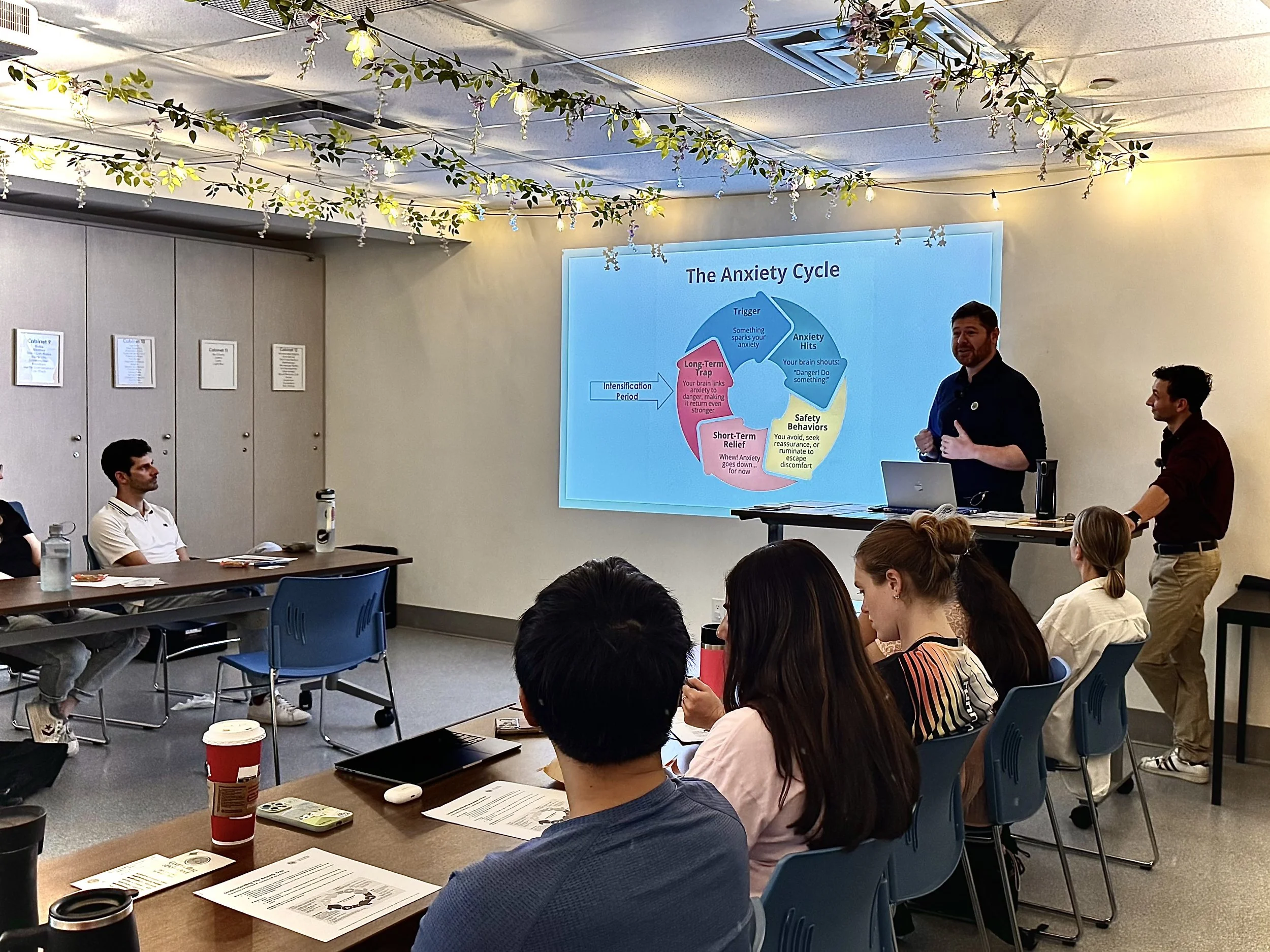
Michael R. Goldberg and Joey Florence present a workshop on the principles of The Anxiety Cycle to a room of teachers in Toronto.
Back-to-school season can bring a lot of excitement, but for some children and teens, it also brings a lot of anxiety.
You might notice more questions than usual:
“What if I don’t know anyone in my class?”
“What if my teacher doesn’t like me?”
“What if the work is too hard?”
For some kids, anxiety is less verbal. Instead, there are stomach aches, headaches, irritability, trouble sleeping, tears in the morning, or suddenly insisting they don’t want to go to school.
As a parent, the natural instinct is to help your child feel better.
You reassure them. You solve the problem. You offer to email the teacher. And when they're really distressed, you might wonder whether letting them stay home is the kinder thing to do.
Sometimes children absolutely do need a break or an accommodation. But when anxiety and avoidance start feeding each other, constantly removing the uncomfortable thing can unintentionally make anxiety stronger.
Understanding why can change the way we respond.
Anxiety is an alarm system
Anxiety is the mind and body’s alarm system responding to something it thinks might be dangerous, difficult, uncertain, or wrong.
And there is plenty of uncertainty at the beginning of a school year.
New teachers. Different classmates. Harder work. Changing routines. Social pressures. A new school or classroom.
Anxiety can show up in the mind as worry, racing thoughts, “what if?” questions, difficulty concentrating, or imagining negative outcomes.
It can also be intensely physical. A child may experience a racing heart, tense muscles, nausea, stomach aches, restlessness, or even freezing and shutting down.
These experiences are real, but one of the most important things we can help children learn is: Feeling uncomfortable does not necessarily mean they are unsafe.
How avoidance can make anxiety stronger
Imagine a child who wakes up on a school morning feeling extremely anxious.
Their stomach hurts. They're overwhelmed. They tell their parent they can't possibly go.
Eventually, the parent agrees that they can stay home. Almost immediately, the child's anxiety decreases.
That relief feels good, but it can also teach the brain:
School made me anxious → I avoided school → I felt better.
The next time school triggers anxiety, the urge to avoid it may become even stronger. This is the anxiety-avoidance cycle, and it isn't unique to children.
Adults do it too: we put off the uncomfortable conversation, avoid making the phone call, skip the social event, or tell ourselves we'll do something once we feel more confident.
The problem is that avoiding anxiety often works beautifully in the short term, and that's precisely why it can become such a difficult pattern to break.
When helping accidentally reinforces avoidance
Parents don't intentionally reinforce anxiety. Usually, the opposite is true. They see their child struggling and genuinely want to help, but regardless of intent, some responses can become part of the anxiety-avoidance cycle.
Removing the discomfort
“They're already overwhelmed. I'll let them skip it today.”
Occasional flexibility is one thing. But if distress consistently results in removing the difficult situation, a child may have fewer opportunities to discover that they can cope with it.
Reassuring over and over
“Don't worry. Your teacher will be nice.”
“You'll definitely make friends.”
“Nothing bad is going to happen.”
Reassurance can be comforting, but anxiety is rarely satisfied for long. Another “what if?” often follows. Instead of trying to guarantee that everything will go well, we can communicate confidence that the child can handle uncertainty.
Gradually accommodating more and more
Maybe a child initially needs support walking into school, but that can turn into them needing a parent to walk them to class. Then they need the parent to stay. Then they begin asking to stay home…
Each accommodation can feel small and reasonable, but over time, the child's world can gradually become smaller.
The question isn't simply, “Does this make my child feel better right now?”
It should also be: “Is this helping them become more able to handle this situation over time?”
What can parents do instead?
The alternative to avoidance isn't forcing a distressed child through something without support. We want to find the space between rescuing and pushing.
Here are a few places to start.
1. Validate the feeling without automatically removing the challenge
Validation doesn't mean agreeing with everything anxiety is telling your child.
You can say: “I believe you that this feels really hard.”
And follow it with: “Let's figure out how we're going to get through it.”
Both messages matter. You're communicating that their experience is real while also showing confidence in their ability to move forward.
2. Make the next step smaller
When anxiety is high, the entire school day can feel impossible. Don't solve the whole day.
Instead ask: “What's the smallest useful step we can take right now?”
Maybe that's getting dressed.
Then eating breakfast.
Then getting into the car.
Then walking to the school doors.
The expectation hasn't disappeared. You've simply made the immediate demand easier for an overwhelmed brain to manage. We sometimes describe this as:
Shrink the task, not the expectation.
3. Offer choices about how, not always whether
Choice can help restore a sense of control, but compare these two questions:
“Do you want to go to school today?”
and: “Would you rather walk in with me or meet your friend at the doors?”
The second still provides choice, but the choice is about how the child moves forward rather than whether they avoid the situation entirely.
4. Shift from reassurance to confidence
If your child repeatedly asks: “What if nobody talks to me?”
You don't necessarily need to convince them that everyone will. Instead, you might say:
“I don't know exactly what will happen today. But I know you can handle things even if they don't go exactly the way you're hoping.”
That's a subtle but important shift.
Instead of teaching: “I can cope because Mom or Dad promised everything will be okay.”
We're working toward: “Even when I don't know exactly what's going to happen, I can handle it.”
5. Don't wait for anxiety to disappear
One of the biggest misconceptions about anxiety is that we need to feel better before we can do something difficult. Often, the opposite is true.
A child doesn't need to feel completely confident before walking into school. They can walk in while feeling nervous; they can give the presentation while their heart is beating quickly; they can sit down for the test while having anxious thoughts.
The goal isn't:
Feel calm → then do the difficult thing.
Often it's closer to:
Take a manageable step → discover you can handle it → build confidence through experience.
Helpful phrases for an anxious child
When anxiety is high, long explanations aren't usually helpful. Keep your language simple.
Try:
“I believe you that this feels hard. Let's figure out the next step.”
“You can feel nervous and still do this.”
“We can make the step smaller without making the goal disappear.”
“Your anxious brain is predicting something bad. We don't have to argue with it, and we don't have to obey it.”
“What's the smallest useful step?”
“You don't need to feel completely ready before you begin.”
These responses acknowledge anxiety without making the disappearance of anxiety a requirement for moving forward.
The bigger lesson
Children will experience uncomfortable things at school.
There will be difficult assignments, social uncertainty, disappointing grades, conflicts with friends, presentations, unfamiliar situations, and mornings when they would much rather stay home. We can't make all of those experiences comfortable, and we probably shouldn't try. Instead, we can help children gradually build a different relationship with discomfort:
“I don't like this feeling, but I can handle it.”
So when anxiety shows up, instead of only asking: “How do I make my child feel better?”
Try adding another question: “How can I help them take the next manageable step?”
That shift allows us to be supportive without automatically letting anxiety decide what happens next.
When anxiety is getting in the way
Some back-to-school nervousness is a normal part of adjusting to a new year.
But when anxiety or avoidance begins significantly interfering with school attendance, friendships, family life, sleep, or everyday routines, additional support may be helpful.
At Counselling & Behaviour Services, we work with children, teens, adults and families to better understand what's driving anxiety and develop practical strategies for moving forward.